Discussing Online Safety With Teens: Why Connection Matters More Than Control
Date: November 18, 2026
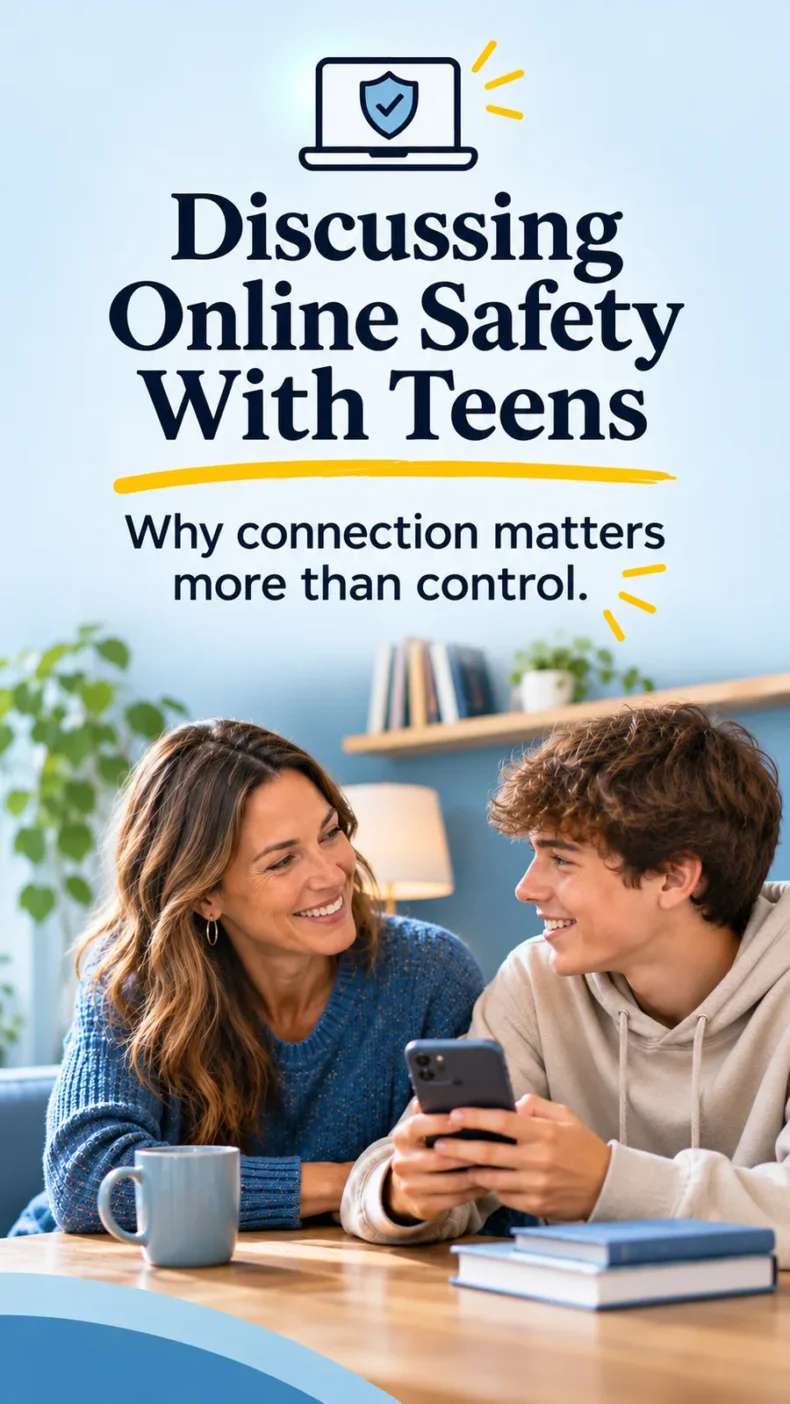
Your teenager is on their phone. Again.
They’re laughing at something in a group chat, scrolling through TikTok, sending pictures on Snapchat, or talking to someone while gaming. You ask what they’re doing, and the answer is usually the same.
“Nothing.”
Or maybe, “Just talking to my friends.”
And there it is. That familiar feeling of wondering what they’re seeing, who they’re talking to, and whether they’re safe.
We worry about cyberbullying, online predators, inappropriate content, scams, and the things our teens might share without understanding the consequences. So we set rules. We monitor accounts. We limit screen time. We remind them not to talk to strangers or share personal information.
But here’s the question I think we need to ask more often: If something went wrong online, would our teenager feel safe telling us?
We can have every parental control available, but we can’t anticipate every conversation or situation our teenagers will encounter. Eventually, they’re going to have to make decisions without us standing beside them.
That’s why I believe online safety needs to begin with something deeper than rules. It needs to begin with our relationship.
Their Online World Is Part of Their Real World
I think one of the biggest mistakes we make as parents is treating our teenagers’ online lives as separate from their real lives.
To us, it might look like endless scrolling or pointless videos. But to them, these spaces are often where friendships happen, interests develop, and connections are maintained. Their group chats are conversations. Their gaming communities are social spaces. Their favorite creators and online interests can become part of how they explore their identities.
That doesn’t mean everything happening online is healthy. It means we need to understand why these spaces matter before we can effectively talk about the risks.
Research published in the Journal of Behavioral Addictions found that stronger family relationships were associated with fewer problematic internet and gaming behaviors, while family conflict was associated with more difficulties. Strict restrictions alone did not consistently produce better outcomes (Nielsen et al.).
When we dismiss everything our teenagers do online as a waste of time, we risk dismissing something that feels important to them. And if they believe we don’t understand their world, why would they invite us into it?
Why Rules Alone Aren’t Enough
Teenagers need boundaries. They need guidance about privacy, online relationships, appropriate content, and the consequences of what they share. But boundaries without communication can quickly become another battle for control.
Research suggests that open conversations about online activities may help reduce problematic internet use, although no single parenting strategy consistently works for every family (Nielsen et al.).
We don’t have to choose between protecting our teenagers and respecting their growing independence. We can do both.
Instead of making every conversation about what they aren’t allowed to do, we can ask questions. What apps are they enjoying? Who are they connecting with? Have they ever seen something online that made them uncomfortable? What would they do if someone asked them to keep a conversation secret?
Not every answer needs a lecture. Sometimes asking questions and listening gives us a better understanding of what our teenagers are experiencing and where they might need guidance.
Will They Tell Us When Something Goes Wrong?
This is the part of online safety I think deserves the most attention.
Imagine your teenager receives an inappropriate message. Someone they thought was a friend starts pressuring them for pictures. A private conversation gets shared. A group chat turns cruel.
What happens next? Do they tell you? Or do they stay quiet because they’re afraid you’ll take their phone, blame them, or become angry?
Research on cyberbullying disclosure shows that teenagers’ willingness to seek help and their perceptions of who can help vary with age. As adolescents grow older, friends may become increasingly important sources of support (Betts et al.).
Another study examining parent-adolescent communication about social media found that parents and teenagers often discuss online experiences less frequently than we might expect. Researchers also found that parental knowledge depends on both parents asking questions and teenagers voluntarily sharing information (Beyens et al.).
I think about how easily our reactions can shape those conversations. A teenager admits they made a mistake online, and our first instinct might be frustration. “Why would you send that?” or “Didn’t we already talk about this?”
Those reactions often come from fear. We’re scared because we understand consequences they may not fully recognize. But if every mistake becomes a punishment, we risk teaching our teenagers that hiding problems is safer than asking for help.
That doesn’t mean removing accountability. It means responding in a way that keeps communication possible.
Sometimes the most important thing we can say is, “I’m glad you told me. Let’s figure out what to do next.”
The Risks Are Real, and We Need to Talk About Them
Building trust doesn’t mean pretending the internet is harmless.
Cyberbullying, harassment, manipulation, exploitation, and privacy violations are real concerns. A meta-analysis of longitudinal studies involving more than 13,000 children and adolescents found that cyberbullying victimization was associated with increased mental health symptoms over time (Lee et al.).
And unlike conflicts that happen only at school, online harassment can follow teenagers home through messages, screenshots, comments, and group chats.
We also need to talk openly about online manipulation. Not everyone who seems friendly has good intentions. Someone may gradually build trust, ask for private information or images, or pressure a teenager to keep secrets.
Our teenagers need to understand why protecting personal information matters, how to recognize suspicious messages, and when to block or report someone. They need to know that screenshots can preserve conversations and that something shared privately may not stay private.
They also need to understand that being manipulated, threatened, or exploited is not their fault. Even if they made a mistake or shared something they shouldn’t have, they still deserve help.
Teaching Safety Without Taking Away Independence
One of the hardest parts of parenting teenagers is knowing when to step in and when to step back. We want to protect them, but we also want them to learn. We want to respect their privacy while recognizing when something may be unsafe.
What works for a thirteen-year-old may not be appropriate for a seventeen-year-old. Boundaries should evolve as teenagers demonstrate responsibility and develop better judgment.
That might mean reviewing privacy settings together instead of secretly changing them. Talking through questionable messages instead of immediately demanding access to every conversation. Establishing clear expectations while explaining the reasons behind them.
And it means making space for everyday conversations that aren’t about danger.
Ask them to show you a funny video. Learn about the game they love. Let them explain why a particular creator, fandom, or online community matters to them.
You don’t have to love everything they love. You don’t even have to understand all of it. But showing interest communicates something important: Your world matters to me because you matter to me.
The Relationship Is the Safety Net
I don’t think we can create a completely risk-free online world for our teenagers. We can establish boundaries, teach digital literacy, monitor when necessary, and help them recognize dangerous situations. Those things matter.
But we can’t control every interaction. And as our teenagers grow, we shouldn’t expect to.
I want teenagers to understand that asking for help isn’t weakness. That making a mistake doesn’t mean they have to face the consequences alone. And that someone else’s manipulation or cruelty doesn’t define their worth.
And I want parents to remember that connection isn’t the opposite of discipline. It’s part of what makes guidance possible.
Sometimes protecting our teenagers means setting a firm boundary. Sometimes it means stepping in immediately when they’re in danger. And sometimes it means sitting beside them, listening without judgment, and helping them work through something they don’t know how to handle.
We spend so much time worrying about what our teenagers might encounter online that sometimes we forget to ask whether they’ll feel comfortable telling us when something happens.
That’s the relationship piece we can’t afford to overlook.
We won’t always be able to stand between our children and the world. But we can work to become the people they turn toward when the world becomes overwhelming.
So, stay curious. Stay involved. Stay connected.
Because the most important safety feature our teenagers have may not be an app, a filter, or a password.
It may be knowing they can come to us.
Works Cited
Betts, Lucy R., Karin A. Spenser, and Thom Baguley. “Describing Disclosure of Cybervictimization in Adolescents from the United Kingdom: The Role of Age, Gender, Involvement in Cyberbullying, and Time Spent Online.” The Journal of Genetic Psychology, vol. 183, no. 1, 2022, pp. 40–53. https://doi.org/10.1080/00221325.2021.2001413.
Beyens, Ine, Loes Keijsers, and Patti M. Valkenburg. “Development, Validity, and Reliability of the Parent-Adolescent Communication about Adolescents’ Social Media Use Scale (PACAS).” Journal of Children and Media, vol. 18, no. 2, 2024, pp. 159–177. https://doi.org/10.1080/17482798.2023.2299828.
Lee, Jungup, et al. “Cyberbullying Victimization and Mental Health Symptoms Among Children and Adolescents: A Meta-Analysis of Longitudinal Studies.” Trauma, Violence, & Abuse, vol. 27, no. 2, 2026, pp. 391–406. https://doi.org/10.1177/15248380241313051.
Nielsen, Philip, et al. “Linking Parental Mediation Practices to Adolescents’ Problematic Online Screen Use: A Systematic Literature Review.” Journal of Behavioral Addictions, vol. 8, no. 4, 2019, pp. 649–663. https://doi.org/10.1556/2006.8.2019.61.