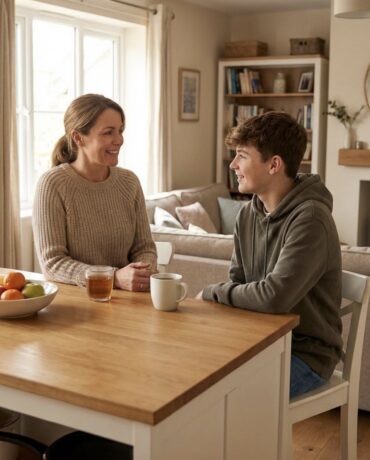
I still remember the first time one of my kids looked at me and said, “No,” with that unmistakable teenage edge. Not the toddler kind of no. Not the playful kind. The firm, sharp, eye-contact-holding kind. It caught me off guard. It wasn’t just the word. It was the tone. The independence in it. The subtle challenge. In that moment, I felt a mix of emotions—surprise, frustration, maybe even a little hurt. It’s amazing how quickly defiance can feel personal....
Looking for easy ways to turn progress into positive family moments? Here are four small, meaningful ways to recognize your teen’s effort—no balloons required! Name the Win Out LoudAt dinner or during a car ride, call out something specific: “I noticed you finished your science project even though it was a tough week.” Sometimes, hearing their effort noticed is the best celebration. Share a Favorite Snack or TreatPause for a quick ice cream run, bake cookies together, or just sit...
There’s a moment many parents know well—the quiet realization that something has shifted. Maybe your teen seems more withdrawn than usual. Maybe their laughter doesn’t come as easily. Maybe you find yourself lying awake at night, replaying conversations and wondering if you missed something important. I remember the first time I considered the possibility of therapy for someone I loved. It wasn’t dramatic. There was no single crisis. It was just a steady accumulation of small changes—shorter answers, longer silences,...
There’s a quiet kind of worry that settles into a parent’s heart when something doesn’t feel quite right. It doesn’t usually arrive all at once. More often, it builds slowly—through small changes in tone, behavior, or energy that are hard to name but impossible to ignore. Sometimes the signs are subtle—a longer pause before they answer, a bedroom door that stays closed more often, laughter that feels forced instead of free. Other times the shifts are more visible: slipping grades,...
If you’re like most families, your days move quickly. Between school schedules, work demands, activities, and the constant buzz of technology, it can feel hard to find moments of true connection. Sometimes what we need most isn’t more structure or more planning—it’s simply a pause. Mindfulness doesn’t have to mean long meditation sessions or perfectly quiet rooms. In fact, some of the most meaningful mindful moments happen in small, ordinary spaces—around the dinner table, in the car before school, or...
There comes a point in every parent’s journey with their teen when boundaries feel less like helpful guideposts and more like friction points. You set expectations because you want your child to stay safe, make good choices, and grow into a capable adult. But sometimes it feels like the more you try, the more your teen pushes back — as if every boundary is a wall instead of a bridge. I’ve been there too: wanting consistency without rigidity, wanting respect...
Social and Emotional Learning (SEL) is all about helping young people build skills for self-awareness, emotional regulation, and positive relationships. If you’re anything like me, you know how easy it is to focus on what’s stressful: the missed assignments, the sibling squabbles, or the quiet moments when your teen seems a million miles away. A few years ago, I stumbled on a tiny habit that began to shift that focus in my own home—gratitude journaling. Gratitude journaling is the practice...
K-pop, a world wide phenomenon and your teen is wearing the hoodie, the bracelet, the tour shirt. Their phone lights up with livestream notifications. They stay up watching comeback stages, unboxing albums, memorizing lyrics, reading fan theories, trading photocards, voting in polls, defending their favorite artist in comment sections, counting down to releases like holidays. They talk about members like friends. They save screenshots. They learn inside jokes. They ask for concert tickets instead of birthday parties. Is it healthy...
There’s a moment that melts every parent’s heart and terrifies it at the same time — the moment a child makes a mistake, looks us in the eye, and says, “It wasn’t my fault.” It’s that instinctive desire to protect them that often kicks in first. We swoop in, fix the problem, and spare them from confrontation. But what if holding back sometimes teaches more than stepping forward? Teaching accountability isn’t about catching teens in wrongdoing. It’s about helping them...
When my kids were little, I used to tie their shoes every morning without thinking much about it. It was faster. Easier. We were usually running late. One morning, I paused and said, “I think you can do this.” It took longer. There was frustration. One shoe came undone. The other had to be retied completely. But when both laces were finally knotted—uneven and imperfect—the pride on my child’s face said everything. That moment has stayed with me. Not because...