The Teenage Brain Explained: Why Mood Swings, Risk-Taking, and Impulsivity Are Normal
Date: May 7, 2026
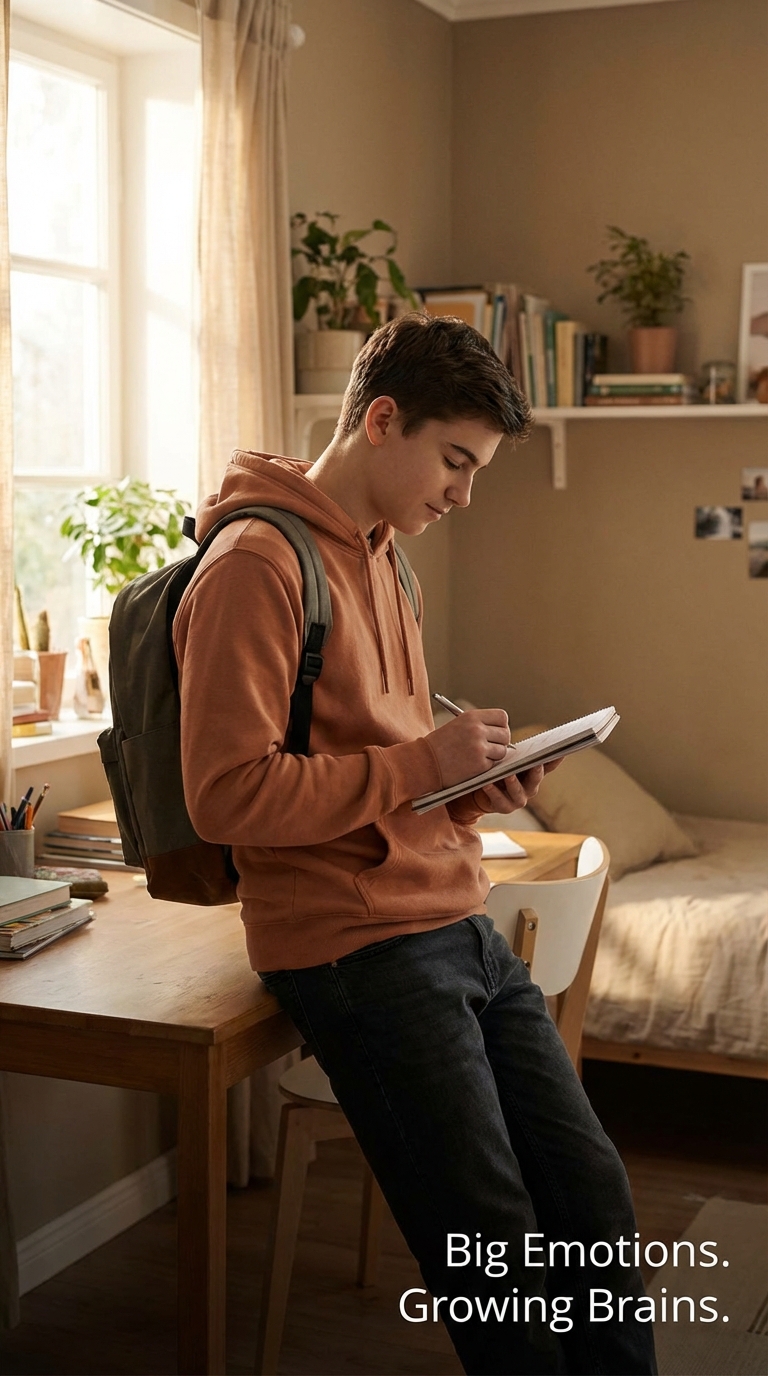
If you’ve ever watched your teen switch from laughing at dinner to slamming their bedroom door within minutes, you’re not imagining things—something really is going on inside their brain. Scientists now know that adolescence is not just a time of emotional drama, but also a period of enormous brain growth and reorganization. When parents understand what’s happening neurologically, it becomes easier to see behavior shifts not as defiance, but as a natural part of development.
The Brain Under Construction: Understanding Adolescent Brain Development
One of the most important discoveries about the teenage brain is that it doesn’t stop developing at childhood. Instead, it keeps changing and refining well into the mid-twenties. Two key processes drive this growth: pruning and myelination.
Pruning works like spring cleaning—unused brain connections get trimmed away while the frequently used ones grow stronger (Blakemore & Choudhury, 2006). Myelination, on the other hand, adds a fatty coating around pathways to make signals travel faster (Casey, Jones, & Hare, 2008). These changes explain why teens may suddenly abandon a hobby they once loved in favor of a new passion, or why they sometimes struggle with organization.
Parent help: Encourage routines like healthy sleep and downtime, but also expect shifting interests. It’s the brain’s way of figuring out what really matters.
The Gas Pedal vs. The Brakes: Why Teens Take More Risks
Brain growth doesn’t happen evenly. Think of it like a car: in adolescence, the gas pedal develops faster than the brakes. The emotional and reward-seeking limbic system matures quickly, while the prefrontal cortex—the part responsible for long-term planning and self-control—catches up much later (Steinberg, 2010).
That’s why teens often chase excitement without fully weighing the risks. Sneaking out to meet friends, prioritizing video games over homework, or trying something reckless isn’t necessarily rebellion; it’s a reflection of a brain built for speed without all the safety features installed yet.
Parent help: Set clear boundaries and let natural consequences teach. If a late night leads to missed practice, the experience itself reinforces responsibility better than a lecture.
Why Teen Emotions Run So High
Research shows that during heated moments, teens’ brains light up more strongly than adults’, especially when peers are involved (Galván, 2010; Somerville & Casey, 2010). This makes them more impulsive in “hot” situations than in calm ones.
That’s why a minor frustration might explode into a shouting match or why a teen may take a risky dare to impress friends even though they know it’s dangerous.
Parent help: Avoid escalating. Staying calm and giving space creates room for problem-solving later. Offering positive outlets for risk-taking—like sports, theater auditions, or outdoor adventures—channels that hunger for excitement in safer directions.
Executive Function: The Steering Wheel Still Developing
Executive functions, sometimes called the brain’s steering wheel, are also still under construction. Skills like time management, flexible thinking, and focus are developing through adolescence (Best & Miller, 2010).
This explains why your teen might do their homework but forget to turn it in, or why they procrastinate until the last possible minute. It’s not laziness—it’s wiring still being fine-tuned.
Parent help: Break tasks into smaller steps, set visual reminders, and celebrate effort rather than perfection. Over time, these strategies strengthen the mental muscles teens need to manage themselves independently.
Sleep, Stress, and the Adolescent Brain
Even factors outside of brain wiring play a huge role. Sleep, for example, becomes tricky during adolescence. Teens’ natural body clocks shift later, yet early school start times often leave them chronically sleep-deprived (Crowley, Acebo, & Carskadon, 2007). This lack of rest can make them irritable, forgetful, and unfocused.
Stress works much the same way. Ongoing pressure floods the brain with cortisol, which can interfere with memory and decision-making (Lupien et al., 2009). Parents may notice this when their teen drags through the morning or snaps over small issues.
Parent help: Support consistent sleep routines, limit late-night screen time, and teach stress-reducing habits like deep breathing, journaling, or exercise.
Parenting Through Brain Development With Empathy and Steadiness
When you put all of this together, the big picture becomes clearer: teens aren’t acting out because they’re broken or deliberately difficult. Their brains are in the middle of a massive construction project. Impulsiveness, mood swings, and risk-taking are byproducts of growth, not character flaws.
For parents, this knowledge is powerful. It reminds us to expect ups and downs, to stay consistent with boundaries while offering room for independence, and most importantly, to model the calm regulation we hope they’ll learn.
Adolescence can feel overwhelming, but it’s also an incredible stage of transformation. The same curiosity, energy, and intensity that frustrate parents are also what prepare teens for the challenges of adulthood. By seeing their behavior through the lens of brain development, parents can shift from reacting with anger to guiding with empathy—offering the steady presence their teen needs most.
Parenting through these years is not easy. You may feel exhausted by the mood swings or frustrated by the risks your teen takes. But remember—every time you choose to listen instead of yell, to guide instead of shame, you’re building trust. You’re showing up, and that matters more than perfection. Your steadiness becomes the anchor they need while their brain—and their world—feels unsteady.
References
Best, J. R., & Miller, P. H. (2010). A developmental perspective on executive function. Child Development, 81(6), 1641–1660.
Blakemore, S. J., & Choudhury, S. (2006). Development of the adolescent brain: Implications for executive function and social cognition. Journal of Child Psychology and Psychiatry, 47(3–4), 296–312.
Casey, B. J., Jones, R. M., & Hare, T. A. (2008). The adolescent brain. Annals of the New York Academy of Sciences, 1124(1), 111–126.
Crowley, S. J., Acebo, C., & Carskadon, M. A. (2007). Sleep, circadian rhythms, and delayed phase in adolescence. Sleep Medicine, 8(6), 602–612.
Galván, A. (2010). Adolescent development of the reward system. Frontiers in Human Neuroscience, 4(6), 1–9.
Lupien, S. J., McEwen, B. S., Gunnar, M. R., & Heim, C. (2009). Effects of stress throughout the lifespan on the brain, behaviour, and cognition. Nature Reviews Neuroscience, 10(6), 434–445.
Somerville, L. H., & Casey, B. J. (2010). Developmental neurobiology of cognitive control and motivational systems. Current Opinion in Neurobiology, 20(2), 236–241.
Steinberg, L. (2010). A dual systems model of adolescent risk-taking. Developmental Psychobiology, 52(3), 216–224.