The Power of Showing Up: Why Daily One-on-One Time With Your Teen Counts
Date: April 16, 2026

Why Family Connection Still Matters in the Teen Years
Do you remember those old public service campaigns about eating dinner together as a family? You’d see commercials reminding everyone to sit at the table, turn off the TV, and talk to each other—just for one meal. It felt a little idealistic at the time, but the message stuck. And as it turns out, they were onto something.
Over the past couple decades, study after study has shown that families who share regular meals experience a whole host of benefits—especially for teens. We’re talking better grades, stronger self-esteem, lower rates of substance use, and even more resilience in the face of bullying. All from something as simple as showing up at the same table a few times a week.
But here’s where it gets interesting: it wasn’t just the food that mattered. It was the connection. The small, everyday ritual of checking in. Making space. Being present.
That same principle applies beyond the dinner table too.
Understanding Teen Mixed Signals and Emotional Needs
Teenagers are masters of mixed signals. One minute they’re asking for help with a school project, the next they’re retreating behind a closed door with a “Don’t come in” sign—real or implied. It’s easy to assume they don’t want time with us, but the truth is, they still need us. They just show it differently now.
I’ve had moments where I wasn’t sure if I was making any difference. The conversation had one-word answers. The eye contact was minimal. The energy? Distant at best. But I’ve also learned that consistency matters more than perfection—and that simply being there, without an agenda, has more impact than we think.
What Research Says About One-on-One Time With Teens
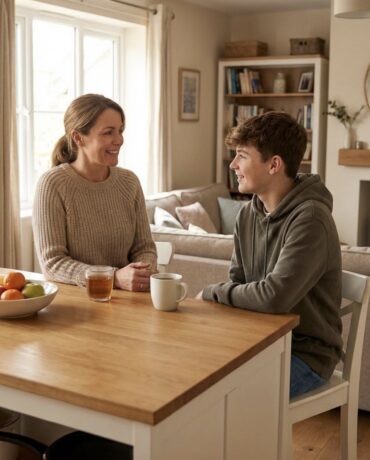
It turns out, even small amounts of daily one-on-one time with a parent can make a real difference in a teen’s life. Studies have shown that when teenagers regularly spend time alone with a parent—whether that’s on a walk, during a drive, or just sitting at the kitchen counter—they tend to have higher self-esteem, better peer relationships, and even lower levels of stress.
One Penn State study found that teens who spent more one-on-one time with a parent, especially fathers, developed stronger social skills. Another daily diary study showed that teens felt noticeably better—happier, more connected—on days when they had supportive interactions with a parent. That’s powerful stuff.
Building Trust Through Consistent Daily Presence
This isn’t about planning elaborate outings or having deep heart-to-hearts every night. It’s about carving out small pockets of time that are just theirs. A window where they don’t have to compete with work emails, younger siblings, or the evening news.
When that time becomes part of your routine—something they can count on—it builds trust. It creates a quiet message: You matter. I’m here. Even if they don’t say much in return, they hear it.
Over time, these little moments add up. They become the foundation for bigger conversations, smoother conflict resolution, and stronger emotional bonds. It also gives you a better read on how they’re really doing—what’s underneath the silence or sarcasm.
What Daily One-on-One Time Looks Like in Real Life
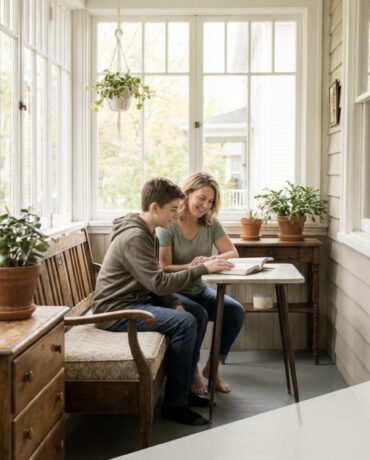
Fifteen minutes before bed. Sit on the edge of the bed, ask about their day. No pressure to perform, just presence.
Car rides. Use that no-eye-contact time to your advantage. Teens often open up when they don’t feel on display.
Shared tasks. Fold laundry together. Walk the dog. Bake something. Side-by-side is often easier than face-to-face.
Lean into their interests. If they’re into music, ask about a song. If they’re into gaming, let them show you how it works. You don’t have to love it—just care that they do.
Some days it won’t click. You’ll show up and they’ll be grumpy or distracted. That’s okay. The point isn’t the moment—it’s the pattern. The quiet rhythm of “I’m still here” that builds security even when words are scarce.
Why Your Presence Matters More Than You Realize
This stage of parenting can feel like a moving target. But one thing holds steady: your presence matters. More than you know.
Have you found ways to stay connected with your teen, even in the quiet seasons? Share your go-to routines or ideas in the comments—we’re all learning as we go.
References
Blakemore, S.-J., Burnett, S., & Dahl, R. E. (2016). Perception and recognition of faces in adolescence. Developmental Cognitive Neuroscience, 17, 11–24.https://doi.org/10.1016/j.dcn.2015.05.005
Burnett, S., Wadhwa, S., et al. (2023). Facial and vocal emotion recognition in adolescence: A systematic review. Adolescent Research Review. Advance online publication.https://doi.org/10.1007/s40894-023-00219-7
The Family Dinner Project. (n.d.). Benefits of family dinners.https://thefamilydinnerproject.org/about-us/why-family-dinners-matter/
McHale, S. M., Crouter, A. C., & Kim, J. Y. (2011). Time with parents in adolescence: Effects on behavioral and emotional adjustment. Journal of Marriage and Family, 73(3), 653–668.https://doi.org/10.1111/j.1741-3737.2011.00836.x
Ochs, E., & Izquierdo, C. (2009). Responsibility in childhood: Three developmental trajectories. Ethos, 37(4), 391–413.https://doi.org/10.1111/j.1548-1352.2009.01066.x
Ohio State University Extension. (2020). Family mealtime: Why it matters.https://ohioline.osu.edu/factsheet/hyg-5246
Time Magazine. (2014, August 25). Family dinners protect teens from effects of cyberbullying.https://time.com/3223017/dinners-fight-bullying/