Why Teens Act Out: Understanding What’s Really Going On
Date: March 23, 2026
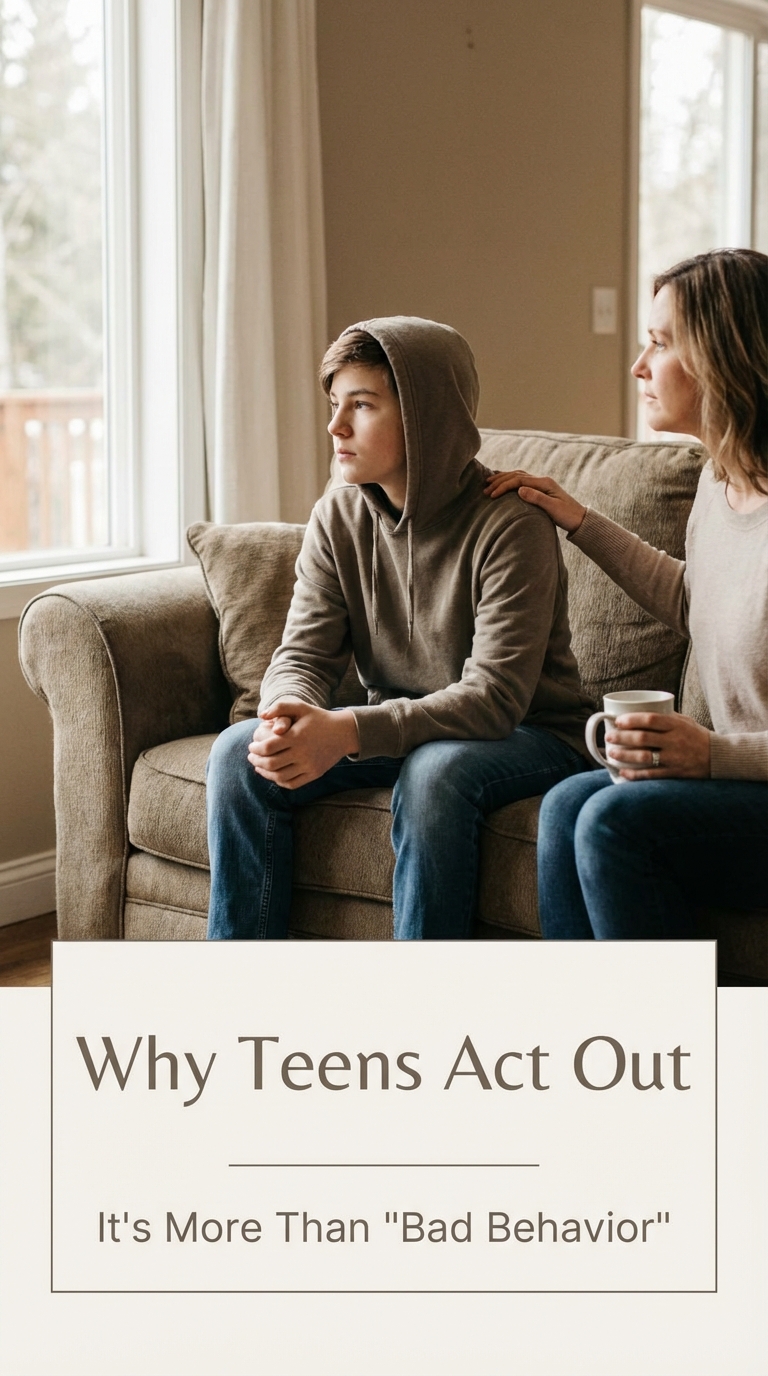
If you’ve ever felt confused or overwhelmed by your teenager’s sudden mood swings or risky choices, you’re in good company. Most parents, caregivers, and teachers have experienced those moments when a teen’s behavior seems to come out of nowhere. When I worked in treatment foster care, I met dozens of teenagers—each with their own story, and each showing their struggles in different ways. Some acted out quietly, withdrawing into themselves. Others did it loudly, testing every limit or rule in sight. It’s easy to wonder, “What’s causing this?” The truth is, acting out is rarely just about “bad behavior.” More often, it’s a response to a complex mix of changes and pressures that are part of growing up.
What’s Happening Inside
During adolescence, the brain is still developing—especially the areas that handle decision-making and self-control. The part of the brain that helps teens think about the long-term consequences of their actions matures more slowly than the part that makes things feel exciting in the moment (Romer, 2010; Chein et al., 2011). This means teens may act on impulse or take risks, especially when they’re with friends. It’s not that teens don’t know right from wrong—it’s just that rewards and peer approval can feel extra powerful right now.
Emotional and Psychological Challenges
Sometimes, acting out is a way for teens to cope with feelings they can’t easily express. Difficult emotions like anxiety, sadness, or the lingering effects of trauma can show up as defiance or withdrawal. Even when teens want to open up, finding the right words isn’t always easy. Research has found that encouraging teens to write about their feelings—even briefly—can help them process emotions and manage behavior a bit better (Frattaroli, 2015; Burton & King, 2004). While writing might not solve everything, it can be a gentle way to help teens make sense of what’s going on inside.
The Power of Friends and the Outside World
Friends and social groups have a huge influence during these years. Teens are naturally wired to care about what their peers think, and being around friends can make risky choices feel more exciting or worth the risk (Chein et al., 2011). Social media, academic pressure, and the urge to fit in can add even more stress. It’s not unusual for teens to understand the risks—they just might feel that being accepted or liked is more important at the moment (Steinberg et al., 2009).
Family Dynamics and Boundaries
Home life matters, too. Clear expectations and consistent boundaries provide much-needed structure for teens, even if they push back against rules. When routines are unpredictable or rules aren’t clear, teens might act out as a way to test where the boundaries really are. On the flip side, a supportive home environment and open conversations can help teens feel more secure as they navigate ups and downs.
A Compassionate Response
It’s important to remember that not every outburst or rebellious streak is a sign of a larger problem—sometimes it’s just a normal part of growing up. Still, if a teen’s behavior is ongoing or disruptive, it might be helpful to reach out for extra support. Simple steps like checking in regularly, inviting your teen for a walk or a drive, or encouraging them to write about their feelings can make a real difference. Above all, patience and understanding go a long way. Every effort you make to understand what’s behind the behavior helps your teen feel seen and supported.
Adolescence can be messy—for teens and the adults who care about them. With a bit of patience, empathy, and curiosity, this challenging journey can become a little easier for everyone.
Works Cited
Burton, C. M., & King, L. A. (2004). The health benefits of expressive writing. Advances in Psychiatric Treatment, 10(5), 398–406. Chein, J., Albert, D., O’Brien, L., Uckert, K., & Steinberg, L. (2011). Peer presence enhances adolescent risk taking by modulating activity in the brain’s reward circuitry. Developmental Science, 14(2), F1–F10. Frattaroli, J. (2015). Experimental disclosure and its moderators: A meta-analysis. Psychological Bulletin, 141(6), 1302–1344. Galván, A. (2023). Reappraising the role of dopamine in adolescent risk-taking behavior. Neuroscience & Biobehavioral Reviews. Advance online publication. Romer, D. (2010). Adolescent risk taking, impulsivity, and brain development: Implications for prevention. Developmental Psychobiology, 52(3), 263–276. Steinberg, L., Albert, D., Cauffman, E., Banich, M., Graham, S., & Woolard, J. (2009). Age differences in sensation seeking and impulsivity as indexed by behavior and self-report: Evidence for a dual systems model. Developmental Psychology, 44(6), 1764–1778. Strang, N. M., Chein, J., & Steinberg, L. (2013). The value of the dual systems model of adolescent risk-taking. Frontiers in Human Neuroscience, 7, 223.